Written by the team at YBL Design & Build, a licensed design-build contractor (CSLB #1152391) serving Orange County and Los Angeles. The permit and code details below are verified against California HCD, the California Coastal Commission, and Orange County city building departments as of August 2026. Rules differ by city, so confirm the requirements with the department that will issue your permit before you commit.
The short answer
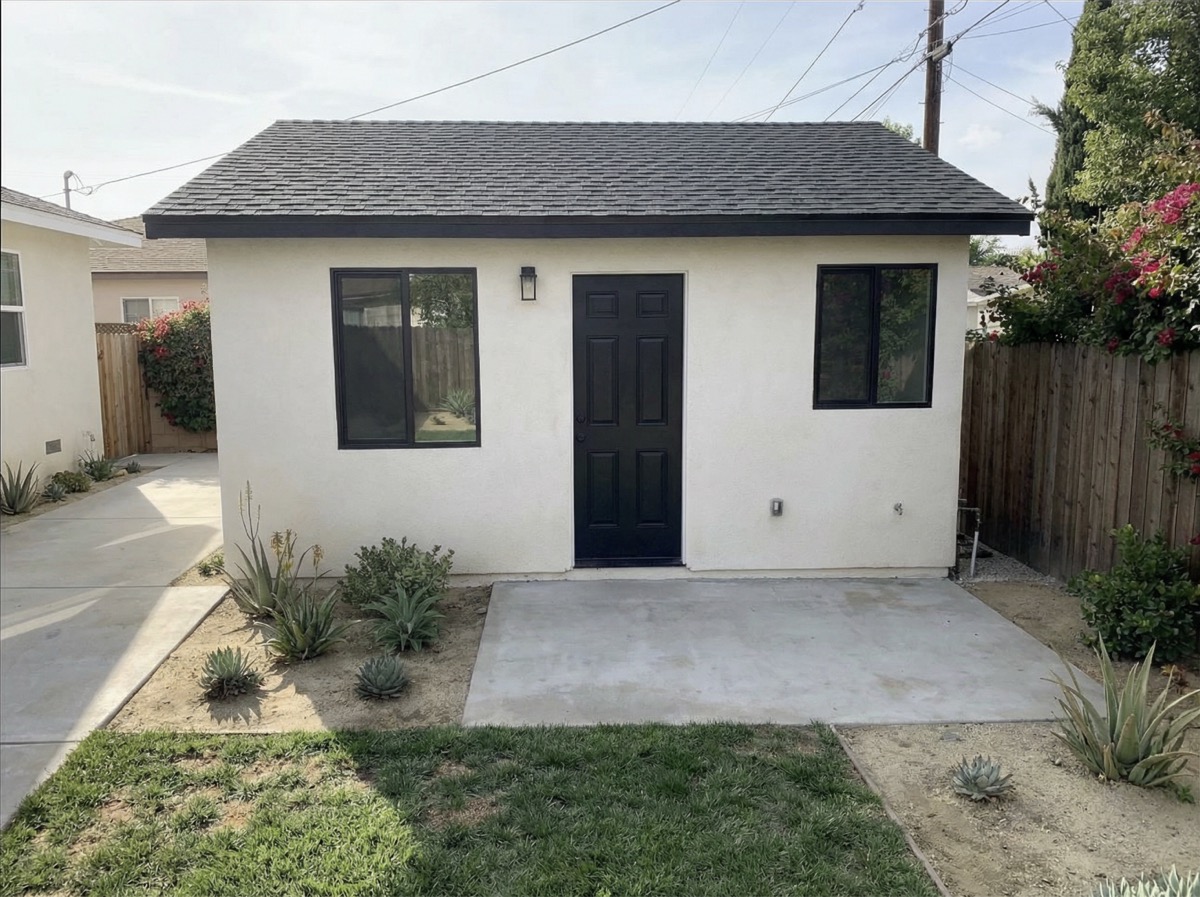
In most of Orange County, you can convert a legally permitted garage into a real, rentable ADU — and state law treats it as a ministerial approval, meaning no public hearing and a decision the city must make within 60 days of a complete application. Two things decide whether it goes smoothly: whether your garage is actually a good candidate (permitted, sound slab, enough ceiling height), and which of OC’s 34 city building departments issues your permit. One rule surprises almost everyone — when you convert your garage, you do not have to replace the parking you lose. And if your home sits near the coast, expect one extra review step.
Part of our homeowner guides to ADUs, additions, and remodels across Orange County and Los Angeles.
Can you legally convert your garage into an ADU in Orange County?
Yes, in almost all cases. California’s ADU laws override most local restrictions and require cities to approve a qualifying ADU through a ministerial process — no discretionary review, no neighborhood hearing, and a 60-day decision deadline once your application is complete. Converting existing space like a garage is one of the most protected paths in the law, because you are reusing a structure that already exists rather than building new.
You do not have to replace the lost parking
This is the single biggest misconception. Under state law, when you remove a garage or other covered parking to build an ADU, you are not required to replace those spaces — even in cities that otherwise enforce strict parking minimums. That means you can turn a two-car garage into a living unit without adding a driveway pad or carport. For many Orange County tract-home lots, that rule is exactly what makes a conversion feasible.
You usually do not have to live on the property
For a standard ADU, California no longer requires the owner to live on-site, so you can build one purely as a rental. A Junior ADU (a JADU — a smaller unit carved out of the existing house and capped at 500 square feet) is the exception and does still require owner occupancy. Confirm which track fits your project, because the two follow slightly different rules.
Which garages make good ADUs — and which don’t
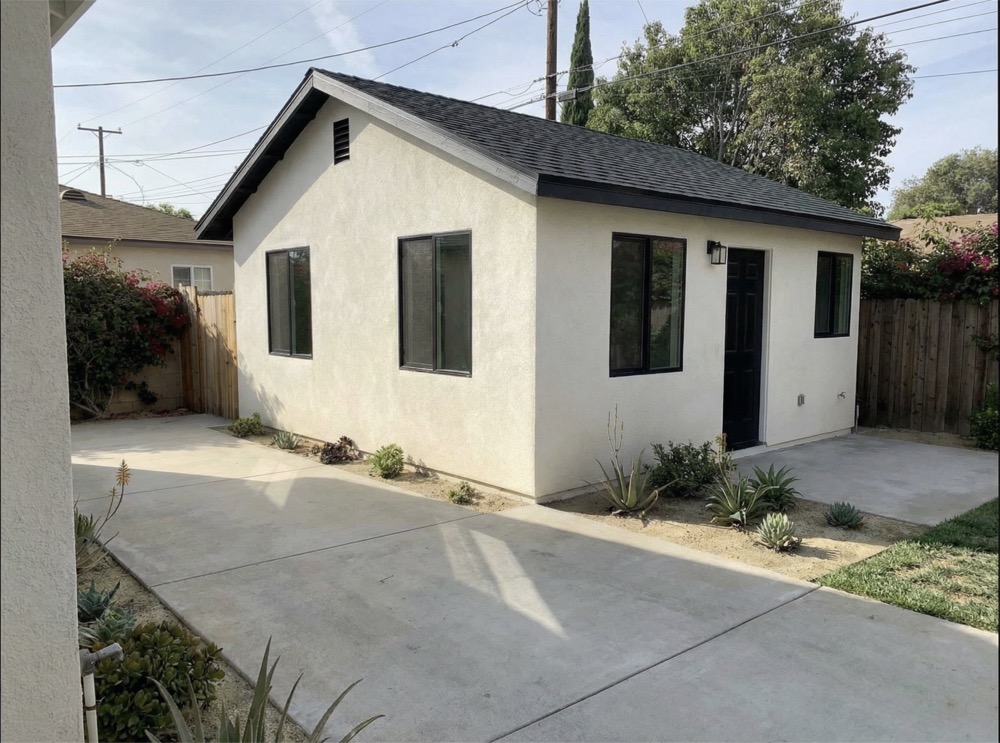
Not every garage is a clean conversion. Much of Orange County’s housing was built between the 1960s and 1980s, and those attached tract-home garages are often strong candidates — but the existing structure is what determines how much you are really building rather than just finishing. As contractors, that is the first thing we assess.
Good candidates
- A garage that was permitted and shows up on your property records
- A sound concrete slab and foundation in good condition
- Enough ceiling height to hit the 7-foot minimum after you add insulation, a finished floor, and a finished ceiling
- A standard detached or attached garage with reasonable access to run plumbing and connect to the sewer
The problem cases
- Unpermitted garages or additions — usually they must be legalized and brought up to code first
- Dirt or badly cracked floors, which mean pouring a new slab
- Tuck-under garages built beneath the house, where converting affects the structure of the home above
- Very low ceilings that cannot reach minimum height without raising the roof
- Drainage, flood, or coastal-bluff conditions that complicate the foundation
None of these kill a project outright, but each one changes the scope and the price. Finding them during design — not after demolition — is the entire point of planning first.
Orange County permits: who actually issues yours
“Orange County” is not one permitting authority. The county has 34 incorporated cities, each with its own building department, plus unincorporated areas. Which office handles your garage conversion depends entirely on your address:
- Incorporated cities such as Anaheim, Santa Ana, Irvine, Huntington Beach, and Fullerton: permitted by that city’s own building department, with its own fees and timelines.
- Unincorporated areas (not inside any city): permitted by OC Public Works.
- Coastal cities such as Newport Beach, Laguna Beach, Dana Point, and San Clemente: may require a Coastal Development Permit on top of the building permit if your property is in the Coastal Zone.
This matters because fees and timelines vary widely between departments. Confirm which one is yours before you assume anything about the process.
What does a garage conversion cost in Orange County?
Cost is driven by the condition of the existing garage and how much of it you are rebuilding, not by a single per-square-foot number. The biggest drivers we see are:
- The slab and foundation — reusing a sound slab is far cheaper than pouring a new one
- Electrical — older OC homes often have an undersized 100-amp panel that needs upgrading to serve a new unit
- Plumbing and sewer — how far the garage sits from existing lines
- Ceiling height and roof — raising a roofline to hit minimum height is a major cost jump
- Insulation, egress windows, and finishes to turn a cold shell into code-compliant living space
As a planning starting point, here are the ranges we use with Orange County homeowners while a project is still being scoped.
| Scenario | Planning range | What drives it |
|---|---|---|
| Straightforward conversion | $120,000–$180,000 | Reusing a sound slab and structure, standard finishes |
| More involved conversion | $180,000–$250,000+ | Panel upgrade, longer plumbing runs, higher-end finishes |
These are planning ranges, not a fixed quote. Your real number depends on your garage’s condition and your finishes, and coastal or higher-end areas trend toward the top. A firm price should come only after the structure is assessed and the design is complete.
Why a coastal garage conversion can cost more
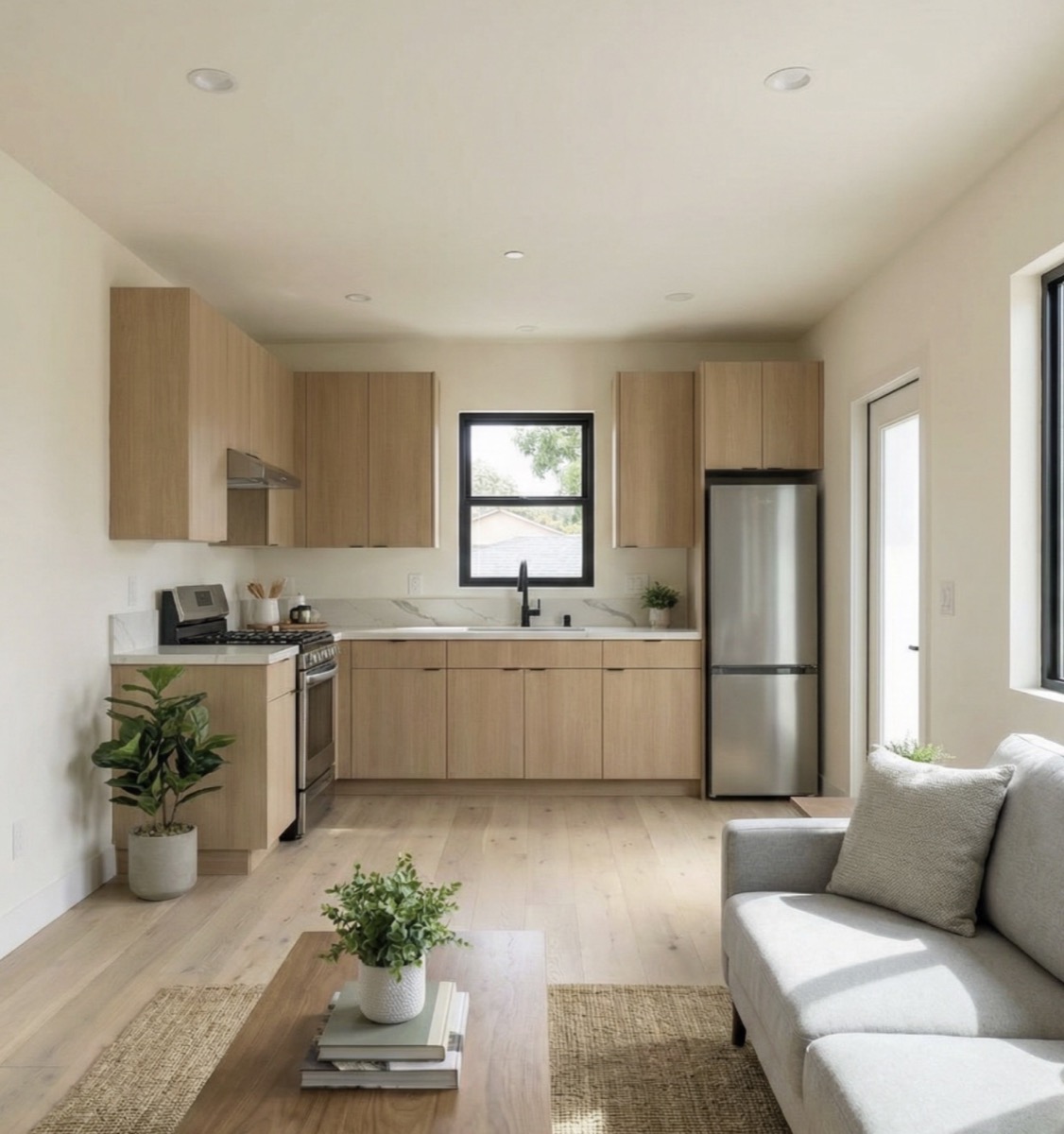
Orange County’s coastal cities change the math. If your property sits in the Coastal Zone, a garage conversion can require a Coastal Development Permit in addition to the standard building permit — an extra review that adds time and, sometimes, design conditions. Add the higher finish expectations common in Newport Beach, Laguna Beach, and Dana Point, plus bluff and drainage conditions on some lots, and the same conversion that pencils in the middle of the range inland can land at the top on the coast. It is not that the coast is arbitrarily more expensive — it is specific, identifiable factors you can plan for once you know your address. You can confirm whether a property falls in the coastal zone through your city and the California Coastal Commission.
How long does a garage conversion take?
Design and engineering usually take several weeks. Plan check varies by city, and coastal review adds time where it applies. Construction for a conversion is typically shorter than a ground-up ADU because the shell already exists — often a few months. The most common delay is not the city; it is an incomplete or under-engineered plan set that draws correction cycles. Time spent getting the drawings right up front is the cheapest time in the whole project.
Frequently asked questions
Do I need a permit to convert my garage in Orange County?
Yes. Turning a garage into living space changes its use and its structure, so it requires a building permit and approved plans, plus electrical, plumbing, and mechanical permits. Doing it without permits creates problems with insurance, resale, and code enforcement later.
Do I have to replace my garage parking?
No. Under state ADU law, when you remove covered parking to build an ADU, you are not required to replace it — even in cities with strict parking rules.
Do I need a coastal permit for a garage conversion in Newport Beach or Laguna Beach?
You might. If your property is in the Coastal Zone, a conversion can require a Coastal Development Permit on top of the building permit. Your city can tell you whether your address is affected, so confirm before you design.
Can I convert an unpermitted garage?
Usually you can, but the city will first want the existing structure legalized and brought up to code, which can mean opening walls for inspection and upgrading older work. It is worth resolving, because only permitted square footage protects your value and your insurance.
How big can my garage-conversion ADU be?
An ADU created within an existing structure can generally match the size of that structure. Separate size caps — commonly up to 850 square feet for a studio or one-bedroom and 1,000 square feet for two or more bedrooms — apply to new construction. Confirm the exact limits with the department issuing your permit.
Weighing a conversion against building new? See our Orange County ADU cost guide and our breakdown of ADU permits in Orange County. Building in LA instead? Our Los Angeles garage conversion guide covers that market. Converting a garage in Long Beach? Our Long Beach ADU guide covers the city’s rules.
Thinking about converting your garage?
YBL Design & Build is a licensed design-build contractor (CSLB #1152391) serving Orange County and Los Angeles. We handle your garage conversion from a free 3D design through permits and construction with one team and one clear, fixed price — and we tell you up front whether your garage is a good candidate and what your city requires. Explore our garage conversion service, see what we build across Orange County, or get a free estimate.