Written by the team at YBL Design & Build, a licensed design-build contractor (CSLB #1152391) serving Long Beach, Los Angeles, and Orange County. The permit and code details below are verified against California HCD and the City of Long Beach Community Development Department (Planning ADU Bulletin IB-PZ-001) as of August 2026. Long Beach reviews ADUs under state law and updates its rules periodically, so confirm current requirements with the city before you commit.
The short answer
Yes — you can build an ADU on almost any Long Beach home, and because the city has not adopted its own local ADU ordinance, your project is reviewed directly under California state law. That has real consequences. A detached, newly built ADU is capped at 800 square feet here, while converting existing space like a garage has no size cap at all. Approval is ministerial — no public hearing, and a decision the city must make within 60 days of a complete application. Two Long Beach specifics catch owners off guard: if your home sits in the coastal zone you will need a coastal permit alongside your building permit, and the city’s pre-approved ADU plans can shorten permitting sharply when a standard design fits your lot.
Part of our homeowner guides to ADUs, additions, and remodels across Long Beach, Los Angeles, and Orange County.
Can you build an ADU in Long Beach?
Yes, in almost all cases. On a single-family Long Beach lot you can generally add one ADU created by converting existing space, one detached newly built ADU, and one Junior ADU — and you do not have to live on the property to rent out a standard ADU. California’s ADU laws require the city to approve a qualifying unit through a ministerial process: no discretionary review, no neighborhood hearing, and a 60-day decision deadline once your application is complete.
Long Beach reviews ADUs under state law — not a local ordinance
Here is what makes Long Beach different from most of its neighbors: the city has not adopted its own local ADU ordinance. Per the city’s Planning ADU Bulletin, every ADU and JADU is reviewed strictly under California state ADU law (Government Code sections 66310–66342). The upside is that the state’s homeowner protections apply cleanly. The catch is that the state’s default size limits apply too — most importantly, the 800-square-foot cap on a detached new build, which we explain below. This is also why the rules can shift: if Long Beach adopts a local ordinance later, some of these standards may change, so confirm the current version before you design.
Long Beach ADU rules at a glance
These are the standards Long Beach currently applies, drawn from the city’s Planning ADU Bulletin. Because Long Beach follows state law directly, they track the state defaults.
| Standard | What Long Beach applies |
|---|---|
| Permitting authority | City of Long Beach — Planning Bureau and Building & Safety Bureau (Permit Center, 411 W. Ocean Blvd.) |
| Approval type | Ministerial, 60-day decision — no public hearing |
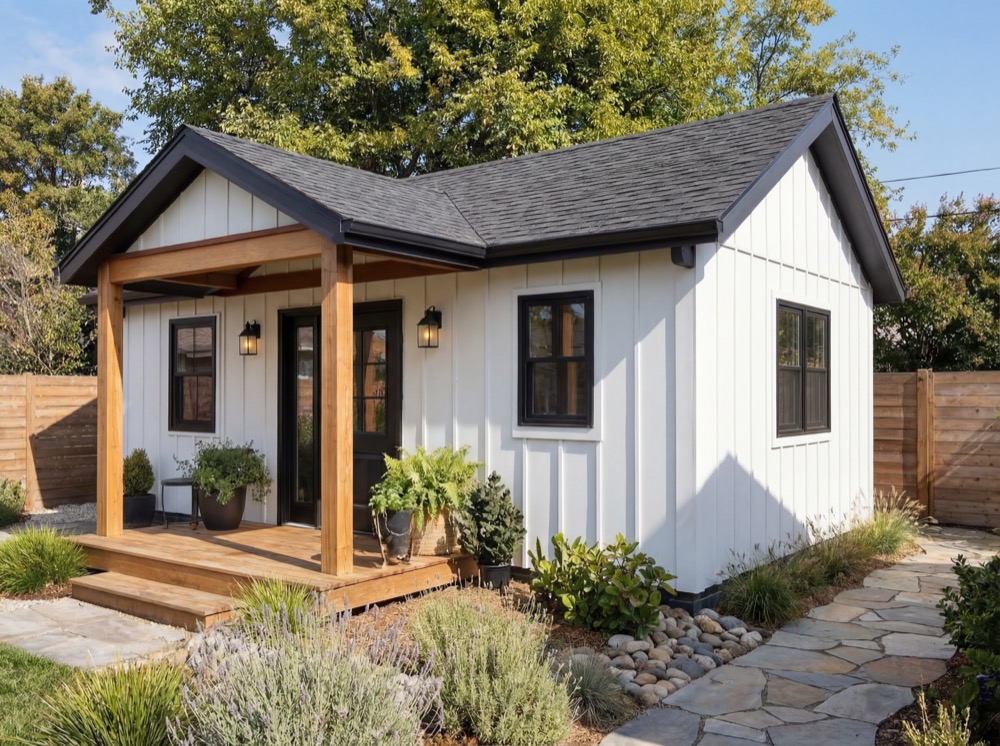
| Detached new-build ADU | Up to 800 sq ft |
| Attached new-build ADU | 50% of the primary home or 800 sq ft, whichever is more |
| Conversion ADU (e.g. garage) | No size limit — matches the existing structure |
| Junior ADU (JADU) | Up to 500 sq ft, conversion only |
| Minimum unit size | 150 sq ft |
| Height | 16 ft, or 18 ft within a half-mile of transit (plus up to 2 ft to match a sloped roof) |
| Setbacks (new construction) | 4 ft side and rear; front per zoning |
| Parking | None required near transit, in a historic district, or for conversions |
| Owner-occupancy | Not required for an ADU (a JADU sharing a bathroom is the exception) |
Source: City of Long Beach Planning ADU Bulletin (IB-PZ-001). Long Beach updates these standards as state law changes, so confirm current limits with the city before designing.
The 800-square-foot surprise
Many homeowners assume they can build a 1,000- or 1,200-square-foot detached ADU because that is what some neighboring jurisdictions allow. In Long Beach today, a detached new-construction ADU is capped at 800 square feet, because the city applies the state default without a larger local allowance. If you want more room than that, the path is conversion, not new construction: converting a garage or other existing space carries no size cap and simply follows the footprint you already have. Knowing this before you design saves you from falling in love with a layout the city will not permit.
The Long Beach pre-approved ADU plans
Long Beach has offered a Pre-Approved ADU (PAADU) program built around a set of designs the city has already reviewed. When one of those plans fits your lot, the plan and permit application can be handled over the counter at the Permit Center, with a building permit potentially issued the same day — because the design work and much of the code review are already done. It is the local equivalent of the pre-reviewed standard-plan programs used elsewhere in the region, and one of the clearest ways to take time and design cost out of a project without cutting construction quality. The city has noted the program is being updated, so confirm current availability and which designs are offered before you count on it.
Prefer a fully custom ADU instead? That is still ministerial and still gets the 60-day clock — it just goes through standard plan check rather than the over-the-counter track. Our ADU cost guide explains how pre-reviewed plans change both cost and timeline.
Coastal zone and historic districts: the extra step
Parts of Long Beach — including Belmont Shore, Naples, the Peninsula, and the downtown shoreline — sit inside the California Coastal Zone. If your property is in it, your ADU needs an Administrative Local Coastal Development Permit filed at the same time as your building permit. There is no public hearing, but it is a real added review that can affect your timeline. Homes in a historic district or at a designated landmark need a Certificate of Appropriateness instead, also filed concurrently and also without a hearing. Neither stops a project — they are predictable once you know your address. You can confirm whether your lot falls in the coastal zone through the city and the California Coastal Commission.
What an ADU costs in Long Beach
Cost is driven by the type of ADU and the condition of your property far more than by any single per-square-foot figure. The biggest swing factors we see are site access, how far water, sewer, and electrical have to run, whether your existing electrical panel needs upgrading to carry a second unit, and your finish level. As a planning starting point, here are the ranges we use with homeowners while a project is still being scoped.
| ADU type | Planning range | Typical size |
|---|---|---|
| Garage conversion | $120,000–$180,000 | Existing garage footprint |
| Small detached ADU | $180,000–$280,000 | ~400–600 sq ft |
| Larger detached ADU | $280,000–$380,000 | Up to Long Beach’s 800 sq ft cap |
These are planning ranges, not a fixed quote. For detached new construction they work out to roughly $350–$500 per square foot. Coastal lots, longer utility runs, a panel upgrade, and higher-end finishes push toward and past the top of each range. A firm price should come only after your property is assessed and the design is complete.
How long does a Long Beach ADU take?
Design and engineering usually take several weeks to a couple of months. Plan check varies — it is fastest when a pre-approved plan fits, and coastal review adds time where it applies. Construction commonly runs several months, and a garage conversion is typically quicker than a detached new build because the shell already exists. The most common delay is not the city; it is an incomplete or under-engineered plan set that draws correction cycles. Time spent getting the drawings right up front is the cheapest time in the whole project.
Garage conversion vs. new detached ADU in Long Beach
Because Long Beach caps detached new builds at 800 square feet but places no size cap on conversions, the choice is not only about budget. A garage conversion reuses an existing slab and structure, usually costs less, and can be larger than 800 square feet if your garage is. A detached ADU gives you a fully separate, purpose-built unit and more design freedom, at a higher cost and within the 800-square-foot limit. If your garage is permitted, structurally sound, and tall enough, a conversion is often the better value — our garage conversion guide covers which garages make good candidates.
How YBL designs and builds your Long Beach ADU
We work design-build, which means one team carries your project from a free 3D design through permits and construction, at one clear price agreed before work begins. For a Long Beach ADU that means we confirm your permitting path up front — whether a pre-approved plan fits, whether you are in the coastal zone, and whether a conversion or a detached build gets you more usable space — so the scope and the number are settled before demolition, not discovered during it.
Frequently asked questions
Can I build an ADU in Long Beach?
Yes. On a single-family lot you can generally add one conversion ADU, one detached new-construction ADU, and one Junior ADU. Long Beach reviews ADUs ministerially under state law, so a qualifying project does not go to a public hearing and must receive a decision within 60 days of a complete application.
How big can a detached ADU be in Long Beach?
A detached, newly built ADU is capped at 800 square feet, because Long Beach applies the state default without a larger local allowance. Converting existing space, such as a garage, has no size cap and can match the structure you already have.
Do I need a coastal permit for an ADU in Long Beach?
If your property is in the California Coastal Zone — areas like Belmont Shore, Naples, and the Peninsula — then yes. Your ADU needs an Administrative Local Coastal Development Permit filed alongside the building permit. There is no public hearing, but plan for the extra review. Confirm your address with the city before you design.
Do I have to replace parking if I convert my garage?
No. Under state ADU law, when you remove covered parking to build an ADU you are not required to replace it, even where the city otherwise enforces parking minimums. Parking is also not required for ADUs within a half-mile of transit or in a historic district.
Does Long Beach have pre-approved ADU plans?
Yes — the city has offered a Pre-Approved ADU (PAADU) program with designs it has already reviewed, which can allow an over-the-counter permit when a standard plan fits your lot. The city has noted the program is being updated, so confirm current availability before you rely on it.
How long does it take to build an ADU in Long Beach?
Design and engineering take several weeks to a couple of months, plan check varies (and is faster with a pre-approved plan), and construction commonly runs several months. Coastal review adds time where it applies, and a garage conversion is usually quicker than a detached new build.
Comparing your options? See our ADU cost guide, our garage conversion guide, and our full range of ADU and garage conversion work.
Planning an ADU in Long Beach?
YBL Design & Build is a licensed design-build contractor (CSLB #1152391) serving Long Beach, Los Angeles, and Orange County. We take your ADU from a free 3D design through permits and construction with one team and one clear, fixed price — and we confirm your Long Beach permitting path, coastal status, and whether a conversion or detached build fits best before design starts. Explore our ADU and garage conversion service or get a free estimate.